

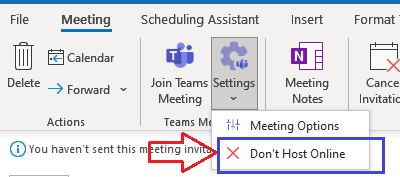
Following on from this post:Office 365 Migrations - What happens to Outlook Meetings with embedded Teams URLs? - Nero BlancoWe developed a tool to strip out Teams info from Calendar invites, so that new Teams info co...
Most popular posts:

Uninstall Microsoft Teams cleanly
Teams Cache CleanerTry this one last time...Start PowerShell as Admin and run:Set-ExecutionPolicy -ExecutionPolicy RemoteSigned -Scope Processtaskkill /IM teams.exe /F /TGet-ChildItem -Path ([System.Environment]:...
Where do emails sent to the default Microsoft Teams email address go?
Where does the default Teams email go?When you first create a Microsoft Team it allocates an email address for the Team. That email address is built by the Display Name (with spaces and special characters remove...
How private are private items in Exchange
We sometimes get asked how private are private items? The short answer is not very… private items is an Outlook and OWA concept and NOT an Exchange concept. Exchange has no item level security model, only mailbox and folder level. So what does this mean? This means that unless you can force people to only access […]
Links and Backlinks in Active Directory for Exchange
In Active Directory (AD) there is the concept of objects, attributes and links between objects. AD Objects AD objects (or more correctly Object Classes) include users, groups, computers, service connection points, OUs, etc. They are the type of things about which we want to store information. An instance of an AD object class is an […]
Convert Mailbox to Linked Mailbox
When performing an AD migration it is sometimes necessary to make the mailbox a linked mailbox so that the migrated user can continue to use their email. When searching online I found the official answer from Microsoft which is to disable-mailbox and then connect-mailbox, however this loses all of the Exchange related attributes. Of course you […]
SMART AD Migrator Architecture
This week we will look more deeply into the Binary Tree SMART AD Migrator software’s architecture, and how to scale up or out. We introduced AD Migrator in an earlier blog called “Introducing SMART AD Migrator from Binary Tree”. If you’ve not heard of the product before it is worth reading the overview first. Right, […]
Merge a MailContact with a User
Often when doing migrations some form of GalSync has taken place or where admins have manually created mailcontacts in the opposite Exchange Org to assist with coexistence. However when it comes time to do the migration the Prepare-MoveRequest.ps1 it will convert the MailContact into a MailUser and ensure it has the mailboxGUID and other attributes […]
Convert Mailbox to Mailuser
I was asked to convert a mailbox to a mailuser, and funny enough although the reverse is true, you can’t just call enable-mailuser on a mailbox… Of course you can disable-mailbox and then enable-mailuser but that removes all Exchange related attributes, which isn’t really that desirable. To overcome this I wrote a small script that […]
Keep up to date, visit our social pages



Introducing SMART AD Migrator from Binary Tree
We’ve just had two days of training using the revamped SMART AD Migrator software from Binary Tree. They’ve had an AD migration tool for some time, but it used to have various issues. These resulted in a total overhaul of the product, and this current release looks to be in a good stable state. The […]
Bandwidth Latency’s Relationship to Throughput
This post aims to explain bandwidth and latency individually and then look at how they relate to throughput. It came about when discussing how some transfers like mailbox moves got nowhere near to using the overall capacity on a network link, and also why SMTP transfers for large emails were taking much longer than expected. […]
Deleting Folders
from an Exchange Mailbox with PowerShell I was given an escalation at a client where somehow a user managed to create thousands of folders all nested one inside the other. So the task was how to delete these folders. User and 1/2/3rd line support had already tried using Outlook, OWA and MFCMapi but none of […]
Sending TLS mail to Exchange from the command line
Before we look at sending TLS mail to Exchange, let’s talk about using a command line to send mail without TLS. The command you use to send plain email to Exchange is the telnet client. It is no longer installed by default but you can install it by adding the Windows Feature for telnet client. Once […]
Demystifying AD Schema Extensions for Exchange
Now most people who have been around Active Directory (AD) will understand about the AD schema and that some applications like Exchange, Lync, etc make updates to this schema. However not everyone is intimately familiar with AD, so let’s start at the beginning… Active Directory 101 Microsoft introduced Active Directory back in the Windows 2000 […]
Microsoft Ignite 2015
Back from Microsoft Ignite, great conference but to be honest it was a bit too big really. 25,000 attendees and the venue was enormous! The food was pretty dire, there were long queues for transportation and the hotels were a long way from the venue. All in all it was a very tiring week and […]